Boat Dock Lines 1/2″ vs 2 Pack 3/8″: Which Size Fits?
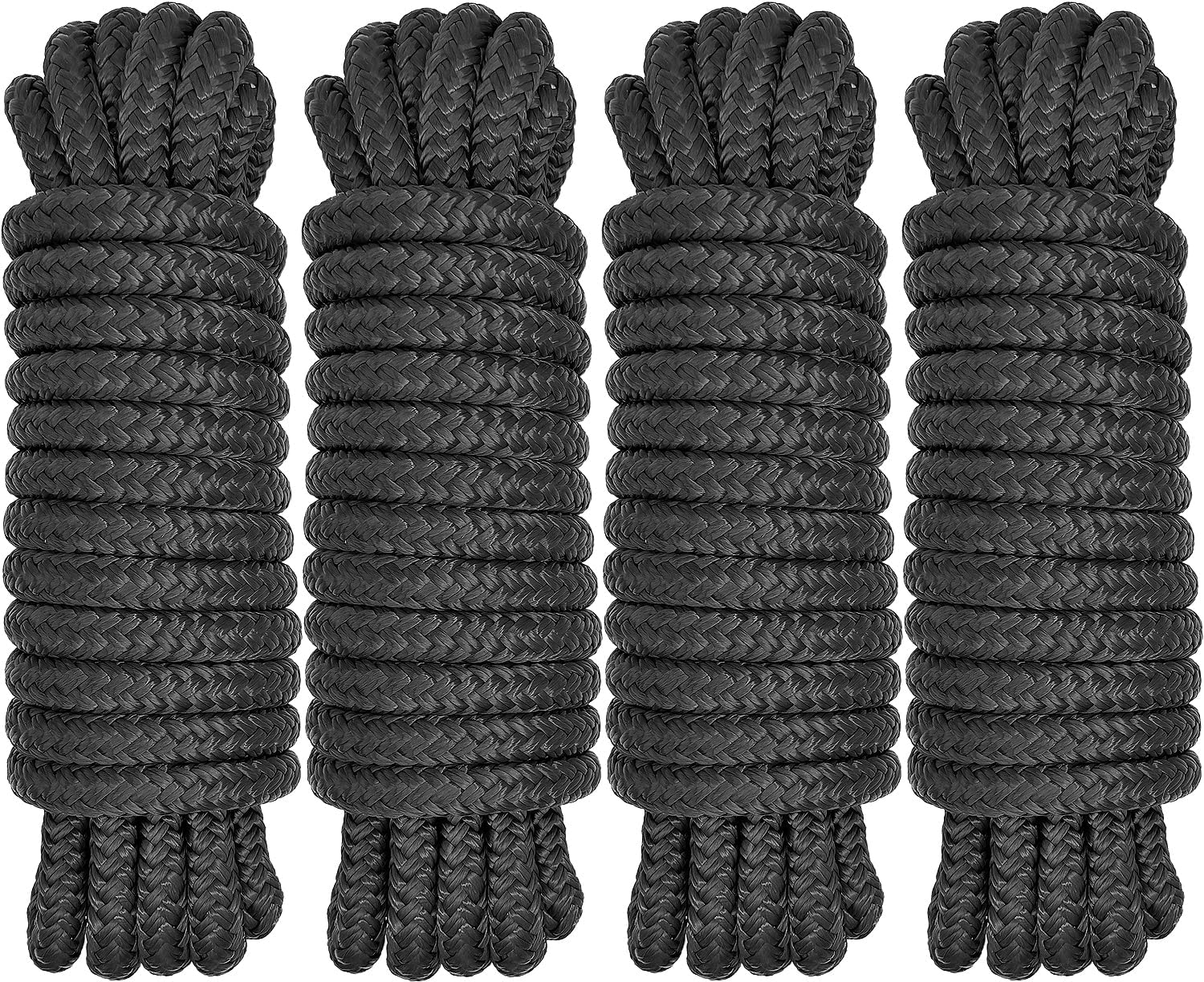
Choosing between Boat Dock Lines 1/2″ x 15′ vs 2 3/8″ x 15′ Dock Lines looks like a simple size question until you notice how differently the two listings read. Both come from PACTHSD, both use black double braided nylon, and both carry a 4.8 star rating, yet one is a four-pack built for boats up to 35 ft and the other is a two-pack aimed at boats up to 25 ft.
The short answer: Boat Dock Lines 1/2″ x 15 suits anyone who wants a complete set of mooring lines for a mid-size cruiser in one order. 2 3/8″ x 15′ Dock Lines suits smaller craft, light duty docking and anyone who wants two easy-handling lines for a kayak, skiff or pontoon. The cards below set out the specs side by side.

| Product | Details | Rating | Buy |
|---|---|---|---|
|
Editor’s Choice
|
Boat Dock Lines 1/2″ x 15 |
★★★★⯪
4.8/5
|
Check on Amazon |
|
Top Pick
|
2 3/8″ x 15′ Dock Lines |
★★★★⯪
4.8/5
|
Check on Amazon |
At a glance
Strip away the packaging and these two lines are close cousins. Both use a double braid, which is a rope construction where a braided core sits inside a braided cover, and both finish with a 12 inch hand-spliced eye, whipped and heat-treated ends, a black colorway and a one-year limited warranty.
The difference is design intent. The 1/2 inch set is a complete mooring kit: four lines, a published 1,380 pound load capacity and a boat size guide that runs to 35 ft. The 3/8 inch set is the budget entry point: two lines for boats up to 25 ft, with enough flexibility to double as fender lines or short-term docking lines.
| Spec | Boat Dock Lines 1/2″ x 15 | 2 3/8″ x 15′ Dock Lines |
|---|---|---|
| Diameter | 1/2 inch | 3/8 inch (0.38 inch listed) |
| Length | 15 ft | 15 ft |
| Lines per pack | 4 | 2 |
| Published load capacity | 1,380 lb | Not listed |
| Boat size in listing | Boats up to 35 ft | Boats up to 25 ft |
| Construction | Double braided nylon | Double braided nylon |
| Eye splice | 12 inch, hand-spliced, whipped and sewn | 12 inch, hand-spliced, whipped and sewn |
| Amazon rating | 4.8/5 from 492 ratings | 4.8/5 from 205 ratings |
| Best sellers rank | #1 in Boat Dock Lines, #9,668 in Sports & Outdoors | #12 in Boat Dock Lines, #25,781 in Sports & Outdoors |
| Warranty | 1 year limited | 1 year limited |
1. Boat Dock Lines 1/2″ x 15
Four lines in one box, a published load figure and the number 1 slot in Amazon’s Boat Dock Lines ranking. If you keep a boat in a marina slip and want bow, stern and spring lines sorted in a single order, this is the set the listing and the reviews point to most often.
Boat Dock Lines 1/2″ x 15: strengths and weaknesses
Where it shines
- It covers a full four-point tie-up. Four lines in the pack means one bow line, one stern line and a pair of spring lines from a single order. A spring line is a dock line that runs fore and aft along the hull to stop the boat surging forward or back at the dock, and it’s the line most two-packs leave you short of.
- It publishes a real load number. PACTHSD lists 1,380 pounds of load capacity for the 1/2 inch line, alongside a boat size guide that runs to 35 ft. That gives you something concrete to check your own hull against, which is more than many budget dock lines offer.
- Nylon double braid is built for shock load. Shock load is the sudden jolt a line takes when a boat surges hard against it, and nylon’s give softens that where a low-stretch fiber would snatch. The braided cover also stands up to abrasion where the rope rubs a chock or a piling.
- The splice work is specified, not vague. Each eye is hand-spliced at 12 inches, then whipped and sewn at the throat and the bitter end, with heat-treated tails to slow fraying. It’s the kind of detail that separates a finished dock line from a length of rope with a knot in it.
- It’s pitched for real weather. The listing covers lakes, rivers, marinas and what it calls challenging conditions, so this is a general purpose line rather than a fair-weather one. Buyer reviews report it holding up through a season of regular docking.
- The track record is the strongest in this comparison. It holds 4.8 out of 5 from 492 ratings, sits at number 1 in Boat Dock Lines and number 9,668 across Sports & Outdoors, and carries a one-year limited warranty. Add a pair of PACTHSD black boat fender lines and your fenders are covered too.
Where it falls short
- Half-inch rope is a handful on small hardware. If your cleats are compact or your chocks are tight, a 1/2 inch line takes more effort to seat and can bind after a couple of turns. On a boat under 25 ft it’s simply more rope than the job needs.
- Black is the only color listed. It looks sharp against a dark hull, but it disappears against a shadowed dock at night. A wrap of reflective tape or a brighter fender line helps you find it in the dark.
- Four 15 ft lines can be too much line. Fifteen feet is generous for a bow line on a 20 ft boat, so you’ll end up coiling surplus or carrying length you never use.
- No stretch percentage or breaking strength figure is published. You get the 1,380 pound load capacity and nothing on elongation, which matters if you’re weighing it against a specialized low-stretch line.
- It’s the bigger outlay of the two. If you genuinely only need two lines, you’re buying rope that stays in the locker for most of the season.
2. 2 3/8″ x 15′ Dock Lines
Read the title carefully and the name makes sense: the listing calls this a 2 pack of 3/8 inch by 15 ft lines, and the diameter field confirms 0.38 inches. So the leading 2 is the pack count, not the thickness. Here’s where the lighter line earns its place and where it runs out of headroom.
2 3/8″ x 15′ Dock Lines: strengths and weaknesses
Where it shines
- Lighter and faster to handle. A 3/8 inch line feeds through a cleat, chock or dock ring with less friction than half-inch rope, coils smaller and weighs less to carry down the dock. Tie up single-handed and you’ll notice that difference on every trip.
- Matched to small boats. PACTHSD names kayaks, smaller sailboats, pontoons, powerboats, fishing boats and skiffs as the intended fits, with a stated ceiling of 25 ft. That’s a sensible band for a 3/8 inch line, and it means the rope isn’t overbuilt for a light hull.
Useful well beyond mooring.
The listing suggests it as a fender line or a short-term docking line too. Fender lines are the short ropes that hang your fenders over the side, and a light 15 ft pair is plenty for that job on most trailer boats.
- Same construction recipe as the bigger set. Double braided nylon, a 12 inch hand-spliced eye, whipped and sewn reinforcement at the throat and bitter end, heat-treated ends and the same one-year limited warranty.
- A sensible way to add spares. Two lines cover a bow and stern tie on a small boat, or give you spares to leave on the dock at your usual slip. It holds 4.8 out of 5 from 205 ratings and ranks 12th in Boat Dock Lines and 25,781st in Sports & Outdoors. If you want a second opinion on the format, our Better Boat 3/8 inch dock line review covers a near-identical two-pack.
Where it falls short
- No load capacity is published. The 1/2 inch line gives you a 1,380 pound figure; this one gives you a boat length guide and nothing more. If you like hard numbers before you commit, that’s a real gap.
- Two lines isn’t a full set. For a four-point tie-up you’d need two packs, which cancels out the pack-count advantage and leaves you with four 15 ft lines either way.
- The size ceiling is low. Boats up to 25 ft is the guidance, and the listing limits use to lakes, rivers, sheltered marinas and short-term docking. Put this line on a 32 ft cruiser in a surge-prone slip and you’re outside its brief.
The name invites mistakes.
Shoppers searching for a 2 3/8 inch line are really looking at a two-pack of 3/8 inch line, and the diameter field is the only place the listing makes that clear. Check the spec table before you order.
- Thinner evidence base. Two hundred and five ratings is a solid sample, but it’s less than half the 492 collected by the 1/2 inch set, so there’s less buyer experience to read through.
Head-to-head
Strength and load capacity: which line holds more?
The 1/2 inch set wins on paper and it isn’t close. PACTHSD lists 1,380 pounds of load capacity and a boat size guide up to 35 ft for the thicker line. The 3/8 inch set publishes no load figure at all; the only guidance is the 25 ft ceiling in the listing copy.
Diameter is the reason. A dock line is a length of rope that ties your boat to a cleat, piling or dock ring, and every extra eighth of an inch of thickness adds material, which usually means more strength and less stretch under strain. What the numbers can’t tell you is conditions: a 25 ft boat in a choppy slip can load a 3/8 inch line harder than a 35 ft boat sitting on a calm lake. Buy for the worst day you expect, not the average one.
Handling and tying: is the thinner line easier to live with?
Yes, and anyone who ties up alone will feel it. Three eighths of an inch feeds through a cleat, chock or dock ring with less friction, coils smaller in a locker and weighs less swinging in your hand as you step off the bow. Half-inch rope is stiffer, and on compact cleats it can bind after two turns.
The trade runs the other way once the line is loaded. Thicker rope is easier to grip when you’re taking strain, and it’s less likely to bite into your palm during a hard pull. Buyer reviews describe the 1/2 inch set as easy handling for its size, and that’s fair, but at the cleat the lighter line still wins on convenience. If your hardware is small, thinner is simply nicer to use.
What do you actually get in each pack?
Four lines versus two is the most practical difference between these products. A typical four-point tie-up uses a bow line, a stern line and two spring lines, so the 1/2 inch set finishes the job in one purchase while the 3/8 inch set leaves you two short and needing a second pack to match.
For a boat with only two tie-off points, which is common on a small pontoon, a kayak rack or a trailer boat you launch each weekend, the two-pack is the sensible buy and the four-pack means surplus rope coiled in a locker. Count your cleats and dock rings before you order. That single step tells you more about value here than any spec sheet.
Is 3/8 inch enough for a small boat or kayak?
For a boat under 25 ft, 3/8 inch is a common size and PACTHSD backs that band. The lighter line doubles as a fender line, packs flat and costs less to replace when it wears. On a kayak, a skiff or a pontoon in a sheltered marina, it does everything you’d ask of it.
The usual size bands look something like this:
- Up to 25 ft: 3/8 inch is a normal starting point for calm water and short docks.
- 25 to 35 ft: 1/2 inch covers most trailerable cruisers and small yachts.
- Over 35 ft: step up to 5/8 inch or heavier, which PACTHSD sells in longer lengths.
- Personal watercraft and kayaks: 3/8 inch or a bungee-style line is plenty.
Where the 3/8 inch line stops is open water, heavy surge and long-term docking on a larger hull. The listing itself limits use to lakes, rivers and sheltered marinas.
Reviews and market position: which one has the track record?
Both hold 4.8 out of 5, so the score itself doesn’t separate them. Volume does. The 1/2 inch set has 492 ratings against 205 for the 3/8 inch pair, and it sits at number 1 in Amazon’s Boat Dock Lines category compared with number 12.
Best sellers rank is Amazon’s sales-based ordering within a category, updated regularly, so it reflects what people are buying rather than an independent measure of quality. Still, a bigger review pool is a bigger sample of real-world use, and the number 1 slot suggests the four-pack format is what most shoppers in this category actually want. In 2026 that gap is wide enough to count as a meaningful signal rather than noise.
Weather, stretch and chafe: do they behave the same?
Largely, yes. Both use double braided nylon with a 12 inch hand-spliced eye, whipped and sewn at the throat and bitter end, and heat-treated tails to stop fraying. Nylon is the stretchy choice among common rope fibers, which is why it gets used for dock lines: some give absorbs shock load instead of transferring it straight to a cleat.
Both come in black, which hides dock grime well and shows up poorly at night. The difference is one of scale. The 1/2 inch line has more material to sacrifice to chafe against a rough piling, while the 3/8 inch line has less thickness to lose before the core is exposed. Neither listing publishes a stretch percentage or a UV rating, so both claims rest on buyer reports. Inspect either line for glazing and fuzz each season, and if you dock in strong sun, our guide to the best boat dock lines for Florida conditions covers what heat and salt do to nylon.
Which one should you buy?
Pick Boat Dock Lines 1/2″ x 15 if you…
Pick it if your boat sits between roughly 25 and 35 ft, if you want one order to cover all four tie-off points, or if you moor in open water, a busy marina or anywhere the boat works against its lines. The published 1,380 pound load capacity and the longer review history are useful reassurances when you can’t inspect the rope first. It’s also the better long-term buy if you plan to replace tired bow and stern lines now and keep the spares for raft-ups or a friend’s boat.
Pick 2 3/8″ x 15′ Dock Lines if you…
Pick it if your boat is under 25 ft, if you only have two tie-off points, or if you want a light pair of lines for a kayak, skiff, pontoon or tender. It’s also the smarter choice if you’re adding fender lines, replacing a worn bow line on a small runabout, or want a spare pair to leave on the dock at your regular slip. Just confirm the 0.38 inch diameter in the spec field before you order, since the product name reads like a much thicker rope.
Other options
If neither quite fits, PACTHSD sells the same double braided line in 5/8 inch and 3/4 inch diameters at longer lengths, which covers boats well beyond 35 ft. Bungee dock lines, which use a stretch cord inside a woven sleeve, are a popular alternative for personal watercraft and quick tie-ups where you want the line to snap back rather than be cleated off. And if you’re shopping on a tight budget, a two-pack of 1/2 inch line is a reasonable middle path for a boat with only two cleats.
| Boat of 30 ft or more with four tie-off points at a marina slip | Boat Dock Lines 1/2″ x 15 |
| Boat up to 25 ft in a calm lake or sheltered marina | 2 3/8″ x 15′ Dock Lines |
| Kayak, skiff or pontoon that needs two lines and a spare fender tie | 2 3/8″ x 15′ Dock Lines |
| You want one order to cover bow, stern and both spring lines | Boat Dock Lines 1/2″ x 15 |
| You tie up briefly and want something light to handle from the dock | 2 3/8″ x 15′ Dock Lines |
Frequently asked questions
What size dock lines do I need for a 30-foot boat?
On a 30 ft boat, 1/2 inch is the usual starting point, and it’s the size PACTHSD lists for boats up to 35 ft. That puts Boat Dock Lines 1/2″ x 15 inside the stated range and leaves the 3/8 inch set outside its 25 ft ceiling. You’d also want four lines: a bow line, a stern line and two spring lines. Fifteen feet is workable for most slip setups at that size, though a longer spring line helps if your pilings are widely spaced.
Is 1/2 inch dock line strong enough for my boat?
For boats up to 35 ft, yes, that’s the band PACTHSD specifies, and the listed load capacity is 1,380 pounds. Strength isn’t only about the rope, though: cleats, chocks and the dock hardware all need to be up to the load too. If your boat is heavier than typical for its length, lives in an exposed slip, or you regularly raft up with others, moving to 5/8 inch gives you more margin.
What is a 2 3/8 inch dock line used for?
Nothing, in the sense the name suggests. The listing title reads “2 Pack 3/8″ x 15′ Dock Lines” and the diameter field confirms 0.38 inches, so the leading 2 is the pack count. What you get is two 3/8 inch by 15 ft lines, sized for boats up to 25 ft: kayaks, skiffs, small sailboats, pontoons and fishing boats. They also work as fender lines or short-term docking lines.
Are 15-foot dock lines long enough for docking?
For most boats up to 35 ft in a standard marina slip, yes. Bow and stern lines are short runs, and 15 ft gives you enough to reach a cleat or piling with a turn or two to spare. Spring lines are the ones that run long. On a boat over 30 ft with widely spaced pilings, a 15 ft spring line can come up short, and a 20 or 25 ft line is the safer call.
Which PACTHSD dock line has better reviews?
Both sit at 4.8 out of 5. The 1/2 inch four-pack has 492 ratings, more than double the 205 on the 3/8 inch two-pack, so it’s the better documented product. It also holds number 1 in Amazon’s Boat Dock Lines category against number 12 for the two-pack. A bigger sample doesn’t prove a better rope, but it does mean there’s more buyer experience to read before you decide.
Should I choose thicker dock lines for heavy weather?
Up to a point. Thicker line carries more material, generally more strength, and more resistance to chafe against a rough piling, which is why 5/8 inch and 3/4 inch lines exist for bigger boats. But diameter has to match the boat and the hardware: a heavy line on small cleats is hard to tie and adds little. For storm prep, doubling up lines, adding chafe gear and checking the dock hardware matter as much as size.
Final verdict
On overall value, Boat Dock Lines 1/2″ x 15 is the pick. Four lines, a published 1,380 pound load capacity, a size band that covers most trailerable cruisers, 492 ratings and the number 1 slot in its category. It’s the set that lets you finish the job in one order, and the extra thickness gives you margin in weather the lighter line doesn’t have. Rating: 4.7 out of 5. It loses points for a black-only finish, no published stretch figure, and the fact that half-inch rope is overkill on a small boat.
2 3/8″ x 15′ Dock Lines is a good rope with a confusing name. Two lines, a 3/8 inch diameter, boats up to 25 ft, the same splice work and the same 4.8 rating from 205 buyers. If you have a kayak, a skiff or a pontoon and you only need two lines, it’s the more sensible purchase and the easier rope to handle. Rating: 4.5 out of 5. The missing load capacity figure and the two-pack format keep it off the top step here.
Affiliate disclosure: This article contains affiliate links. If you buy through them we may earn a commission at no extra cost to you. It does not change which products we recommend.